1. Engineering Context and Purpose
In foundry operations, shot blasting machine capacity is frequently misunderstood and incorrectly specified. Capacity figures quoted by equipment suppliers are often based on idealized assumptions that do not reflect real production conditions. As a result, foundries experience mismatches between expected and actual throughput, leading to bottlenecks, overtime operation, or compromised surface quality.
From an engineering standpoint, shot blasting capacity is not an inherent property of the machine alone. It is the outcome of a controlled process involving time, energy, geometry, and operational discipline.
2. Engineering Definition of Capacity
The number of components that consistently achieve the specified surface cleanliness within one operating hour, under normal production conditions.
This definition excludes short-term peak output, partially cleaned components, and operation without allowance for delays or wear. Capacity must always be linked to a clearly defined surface cleanliness requirement such as Sa 2.5.
3. Primary Engineering Parameters Governing Capacity
3.1 Cycle Time per Batch
Cycle time is the total elapsed time required to process one batch. It includes loading, blasting, indexing or rotation, and unloading. Only blasting time adds value; all other elements are necessary losses and must be included explicitly.
3.2 Number of Components per Batch
The number of components per batch is limited by chamber size, component geometry, orientation, and shadowing. Loading beyond an optimal point reduces cleaning effectiveness and increases rework.
3.3 Available Blast Energy
Blast energy is a function of blast wheel power, number of wheels, abrasive mass flow rate, and effective abrasive velocity. Insufficient energy increases blasting time and directly reduces capacity.
4. Capacity Calculation Formula
Hourly Capacity (components/hour):Hourly Capacity = (60 ÷ Cycle Time per Batch in minutes) × Components per Batch
5. Worked Engineering Example
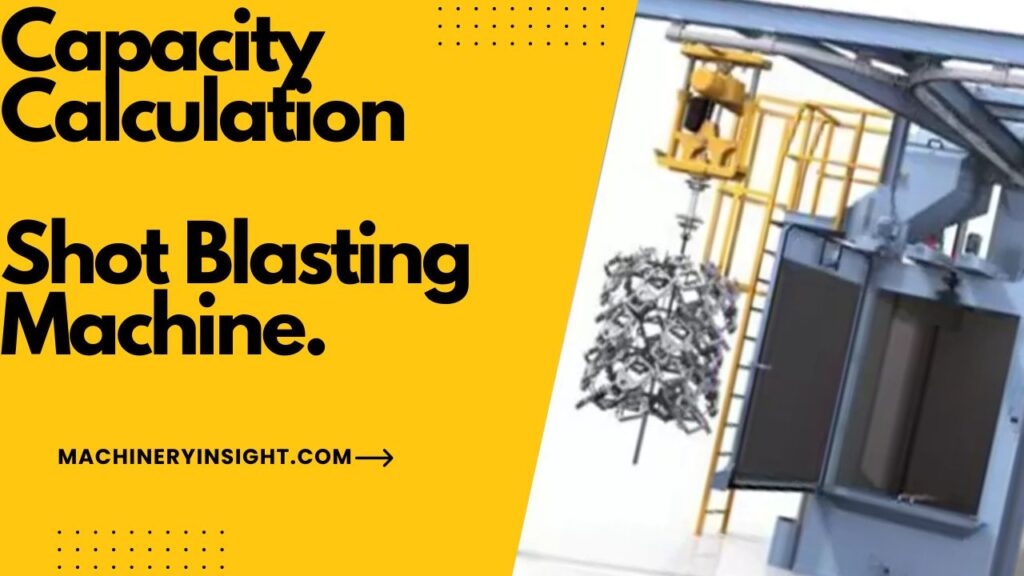
Machine: Hanger type shot blasting machine
Chamber: 1500 × 1500 mm
Blast wheels: 2 × 15 kW
Surface requirement: Sa 2.5 Operation Time (min) Engineering Basis Loading 2.0 Manual crane positioning Blasting 5.0 Verified by cleaning trials Unloading 2.0 Manual removal Total Cycle Time9.0 Sustainable average
Theoretical capacity = (60 ÷ 9) × 20 ≈ 133 components/hour.
6. Practical Efficiency Losses
Real production involves unavoidable losses such as operator delays, abrasive replenishment, separator efficiency drop, and blast wheel wear. Applying a conservative 15% loss factor:
Practical capacity ≈ 113 components/hour
7. Capacity vs Surface Quality
Overloading batches to increase output leads to shadowing, uneven surface finish, and rework. Consistent surface quality at slightly lower throughput results in lower overall cost per component.
8. Engineering Conclusion
Shot blasting machine capacity is an engineered outcome, not a fixed rating. Accurate calculation based on realistic cycle time, batch configuration, and loss factors ensures predictable production, controlled cost, and long-term machine reliability.